 Will Lehman
A high-ranking official of the United Auto Workers apparatus and supporter of UAW President Shawn Fain has posted a death threat against me.
On July 16, Raymond L. Jensen Jr., until recently the assistant director of UAW Region 9—my own region—posted a comment on my public Facebook page in direct response to an article on my campaign statement on the federal criminal investigation into Fain. Jensen’s comment consisted of an AI-generated image depicting me bound with rope and gagged, blood running from my mouth, with a masked man aiming an automatic rifle at my back.
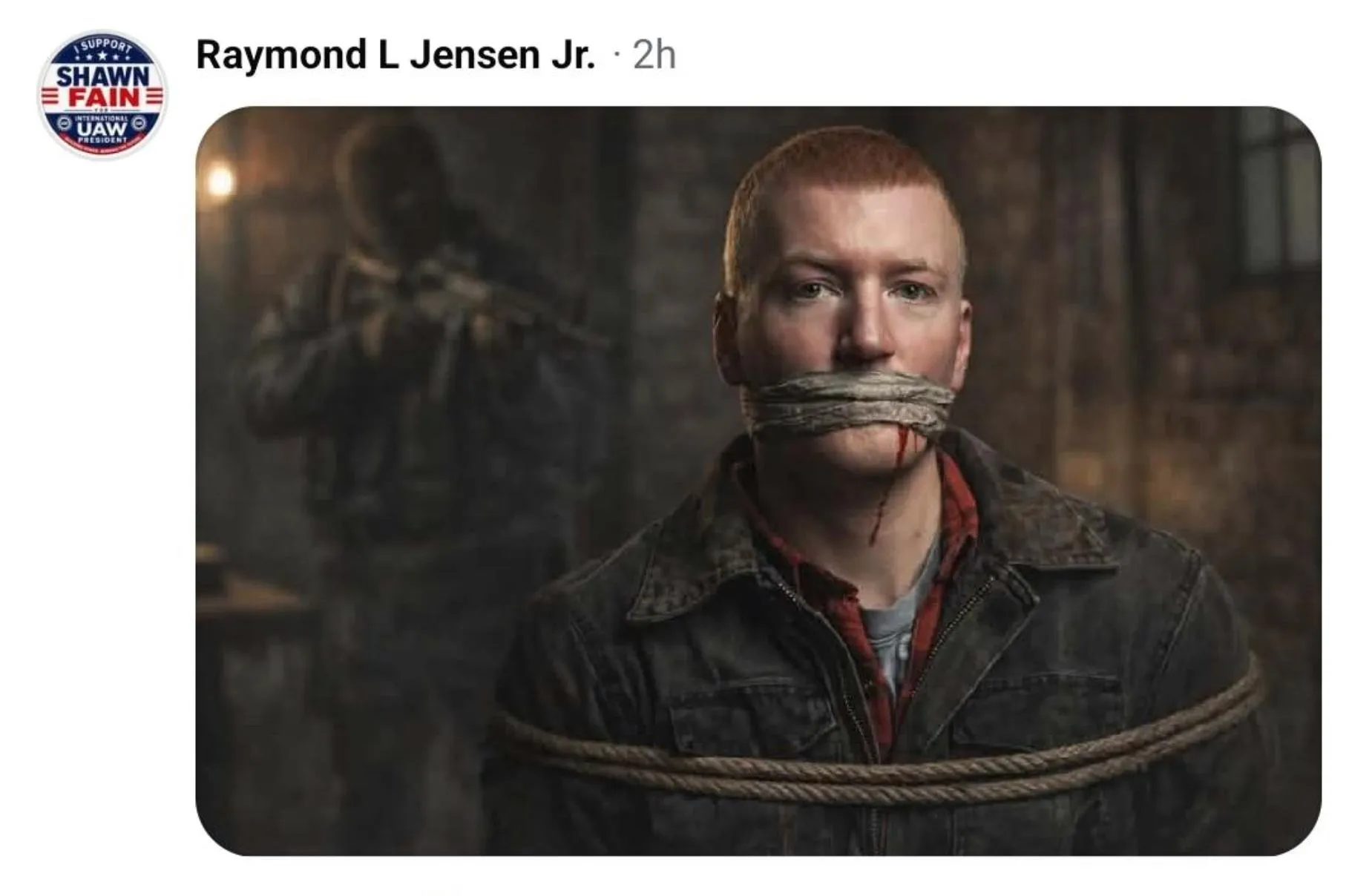
According to the union’s LM-2 filing with the Department of Labor, Jensen’s total compensation in 2025 was approximately $202,000, five times the income of many of the workers whose dues pay his salary. His Facebook profile prominently displays an “I Support Shawn Fain” campaign badge, and his page is filled with statements promoting Fain’s re-election and photographs of Jensen at Black Lake, the union’s resort and conference center in northern Michigan, maintained with the dues of the membership.
In response, my attorney, Eric Lee, has sent a letter to Glen McGorty, counsel for the court-appointed monitor overseeing the UAW, demanding an immediate investigation, the suspension of Jensen without pay, a public repudiation of the threat by the UAW, and referral of the matter to the Department of Labor and federal law enforcement. I have published the full letter here.
“When a highly paid functionary of the incumbent administration, publicly identified with the president’s re-election campaign, posts an image of the opposition candidate gagged, bleeding, and under the gun,” the letter states, “the message transmitted to the UAW membership is unmistakable: extreme violence against Will Lehman is encouraged and enjoys the sanction of the union leadership.”
The image was brought to my attention by co-workers who had seen it on my campaign page. As the letter notes: “We have no way of knowing how many other UAW members—hundreds or even thousands—have already seen Jensen’s provocative image.”
The threat is a federal and legal matter. The Labor-Management Reporting and Disclosure Act guarantees union members the right to express their views on candidates and union affairs, and Section 530 of the Act makes it a federal crime to use or threaten force or violence to intimidate a union member in the exercise of those rights.
Jensen posted the image in response to my statement on the Department of Justice investigation into Fain, in which a federal grand jury has been convened and the UAW monitor subpoenaed. As the letter notes, the monitor’s office has itself determined that Fain and the entrenched UAW leadership have perpetrated what it called a toxic climate of retribution, and that Fain personally threatened to “slit throats” of his opponents.
I have previously filed complaints of harassment and interference with the monitor’s office, which are the subject of a meeting scheduled for July 23. Those complaints, the letter states, “were not seriously investigated. From this inaction, the UAW leadership drew the conclusion that it could threaten Mr. Lehman with impunity. Mr. Jensen evidently shared that confidence.”
The letter refers to the 1969 campaign of the United Mine Workers bureaucracy against the dissident presidential candidate Jock Yablonski:
The campaign of intimidation ended with Yablonski, his wife, and his daughter murdered in their beds on the orders of UMW President Tony Boyle, the assassination financed with union funds. It was that crime, above all, which established why federal supervision of union elections exists—the very authority under which your office operates.
Yablonski was killed because he challenged a corrupt machine whose privileges were bound up with its collaboration with the coal operators. The murders were carried out in an atmosphere deliberately cultivated by the union leadership, in which the dissident had been marked as an enemy. “Even if Mr. Fain and the UAW leadership contemplate no such action,” the letter warns, “the message contained in the image Mr. Jensen posted on Mr. Lehman’s page is unmistakable, and it is being read by others.”
The demands presented to the monitor include a full investigation encompassing “the knowledge, encouragement, or acquiescence of the UAW leadership”; a public repudiation of the threat and formal apology from the UAW, circulated to the entire membership; Jensen’s immediate suspension without pay; referral to the Department of Labor’s Office of Labor-Management Standards and federal law enforcement; and affirmative measures to guarantee that the remainder of the 2026 election is conducted free of intimidation.
The letter concludes: “The Monitor’s response to this incident will be understood—by Mr. Lehman, by the UAW membership, and by Solidarity House—as a measure of whether the protections of the Consent Decree are real.”
The resort to the imagery of violence is a register of the crisis of the entire UAW apparatus. Three years after the “reform” administration of Shawn Fain was installed in an election in which he received the votes of just six percent of the membership, the apparatus faces a federal criminal investigation at the top, open warfare between its leading factions, and—most significantly—a growing rebellion from below.
I will not be intimidated, and this campaign will not be stopped. But this threat is not aimed at me alone. It is an act of intimidation directed against the entire rank-and-file opposition that is developing throughout the UAW. The image of a bound and gagged candidate is meant to teach the membership a lesson: this is what happens to those who oppose the apparatus. If a threat of this character can be made openly, by a highly paid official, against a candidate for the union’s highest office, then no worker who challenges the bureaucracy in their own local is safe.
That is why this cannot be treated as my fight alone, and why the response must come from the rank and file itself. I call on all workers to oppose this act of intimidation: to defend the right of every UAW member to campaign and speak free of threats, to demand the investigation and removal of those responsible, and to circulate this statement in every plant and workplace.
Above all, I call on workers to take up the fight this campaign advances—the building of rank-and-file committees in every plant, independent of the apparatus, and the transfer of power to the shop floor. The apparatus resorts to intimidation because it fears you. The answer is not to retreat, but to organize.
